Every invoice has a different recipient, amount and due date. When tens of thousands of documents accumulate each year, adding their metadata by hand ties up months of work. AI-based metadata extraction in the Profium Digital Archive changes the equation.
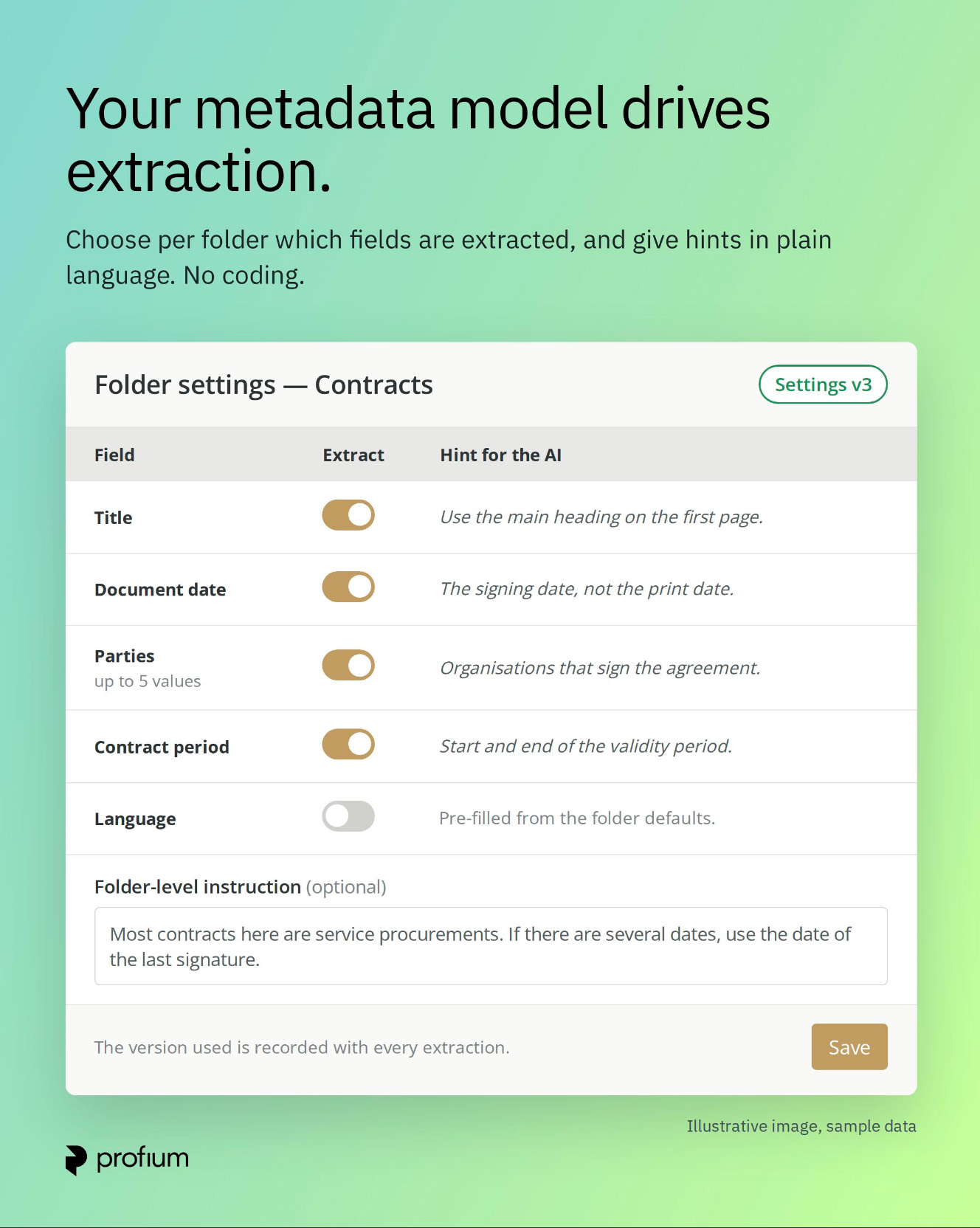
Metadata is the information that describes a document, making it possible to find it in the archive and handle it correctly. In AI-based extraction, the Digital Archive reads the document's text content, and a language model searches it for the information the user has described for each field. If a field's description is, for example, "invoice due date", the model extracts exactly that date from the document and saves it to the correct field in the correct format. The extracted information can include names, dates, Business IDs, account numbers or amounts. Finally, a person approves the suggested values.
In archives, the information common to all documents is usually already described. The bottleneck is the document-specific values, such as an invoice's recipient and amount or the parties to a request for tender, which have to be retrieved from each file separately. When time is short, this is exactly the work that gets left undone, and the information becomes hard to find later.
Tested amid large document volumes
In practice, the feature has been tested with documents from a large Finnish organisation. The organisation produces tens of thousands of financial and administrative documents a year, and its goal is to process hundreds of thousands, even millions, of documents annually in the future.
The test material is varied. Invoices are short and tabular, while requests for tender are long and text-heavy. Most documents are in Finnish, but some are in English. Language has not proven to be an obstacle: the model finds the values even when the field description is in Finnish and the document is in English.
The time savings are significant. If describing one document manually takes two minutes, 10,000 documents amount to roughly 330 working hours a year, or more than two months of a full-time employee's work. With AI, metadata is retrieved in batches, and human effort focuses on review. The client organisation has seen demos of the feature, has been pleased with them and wants to adopt it quickly.
A language model alone is not enough
Simply extracting information from a document is no longer the biggest challenge. The harder part is where the result is stored and how it stays reliable and searchable for years to come.
"Profium already has a product that supports the relationships between metadata and documents, and it was built specifically for public-sector organisations. If an outside party set out to build this so that the data model and long-term preservation were also part of the project, the AI component itself would be only a small part of the whole," says Toni Jutila, Product Manager for the Digital Archive.
Profium's roots in semantic data management mean that AI-generated information fits directly into a ready-made structure designed for public-sector requirements.
Traceable and controlled
Every field extracted by AI is flagged, and a record of the AI extraction is saved with the document.
"A person is always responsible for approval, so the creator of the document is a human, not the AI. The process is documented: you can see which fields the AI extracted," Jutila explains.
The organisation decides for itself how extensive the review is, and as trust grows, it can move from checking every document to spot checks. Nor is the language model locked in: it can be swapped out, and it can run in the cloud or in the organisation's own environment. This is essential when material must not leave the organisation's own systems.
Who is it for?
Automatic metadata extraction benefits most an organisation that has a large volume of material but few resources to describe it. The benefit isn't limited to time saved, as information with metadata is also easier to find later.
"Right now, the language model extracts the metadata, but in the future, that very metadata will make it possible to use language models for retrieving and using information as well," Jutila says.
Would you like to see how AI-based metadata extraction would work with your material? Get in touch and let's arrange a demo.